
Build a Hickman County Former-Owner Timeline
A good timeline grows from the ground up. Start with the newest recorded transfer for the parcel. Follow each seller back to an earlier acquisition of the same land. Hickman County keeps several overlapping sources, and their year coverage differs, so note the gaps. Log every date and name. Add the instrument type, book and page, and land description on its own line. An index hit is a clue, not a finished chain.
| Transfer date | Grantor to grantee | Deed type | Book/page |
|---|---|---|---|
| Newest recorded date | Prior owner to present grantee | As indexed, such as warranty or quitclaim | Copy exactly from the clerk entry |
| Earlier acquisition date | Earlier grantor to the prior owner | As indexed | Use the cited volume and page |
| Repeat for each transfer | Seller becomes the next name searched as grantee | Note fiduciary or corrective instruments | Compare the same legal description |
For the modern trail, begin with the Hickman County Clerk land-records page. When an electronic search comes up empty, the Deed Room terminal and the clerk counter are the next stops. Older digging shifts to record books and Kentucky Department for Libraries and Archives finding aids.
Hickman County's 1795, 1822, and 1981 Layers
Some numbers need context. The clerk reports deeds and mortgages dating to 1795. But that figure describes holdings and indexing depth. It does not promise 1795 images in a free web viewer. Computer records begin in January 1981. The lien and encumbrance index shares that same starting month.
| Source layer | Documented span | Best access | Use in the chain |
|---|---|---|---|
| Clerk computer | January 1981 forward | Deed Room terminal or current electronic route | Start with recent transfers |
| Clerk rolodex | Through December 31, 2010 | Ask staff in the Deed Room | Bridge older indexed names and restrictions |
| KDLA deed microfilm | 1822–1888 and 1902–2016 | KDLA finding aid and archival request | Read earlier deed volumes |
| Clerk's oldest stated holdings | Back to 1795 | Ask the clerk how pre-1822 material is arranged | Continue beyond the listed microfilm |
Coverage alert. A computer result reaching 1981 is not the end of Hickman County ownership history; the older trail continues in rolodexes, books, and microfilm.
Reconstruct Hickman County Ownership in Reverse
Begin with the most recent deed affecting the same parcel, not merely the name currently printed on a tax roll. The PVA assesses ownership as of January 1, so a later closing can leave a former name on that year's roll. The recorded deed supplies the transfer link needed to go backward.
- Locate the newest acquisition deed and confirm the parcel number or full legal description.
- Write down the grantor, grantee, recording date, instrument type, and book/page or instrument reference.
- Search the grantor as a grantee in an earlier period to find how that former owner acquired the property.
- Compare acreage and legal description at each step, then repeat until the computer index no longer reaches.
- Ask for the rolodex, deed book, or cited KDLA microfilm when the electronic trail stops.
- Grantor / grantee
- The conveying party and receiving party named in a deed.
- Chain of title
- The ordered sequence of recorded transfers affecting the same land.
- Reverse index
- An index organized to help locate parties by the opposite transfer role.
- Warranty / quitclaim deed
- Different forms of conveyance; the label alone does not prove the state of title.
- Legal description
- The recorded land identity that remains useful when a street address changes.
Carry Previous Owners into Hickman Deed Books
Once your chain predates the computer era, keep the last reliable book and page close at hand. Include the party names too. The County Clerk sits at 110 East Clay Street, Suite E, in Clinton. Its Deed Room holds public terminals. Staff can tell you where the next entry lives. It might be in a rolodex, a bound index, a deed book, or another local series. Phone contact is 270-653-2131, fax 270-653-2831, or jimbo.berry@ky.gov. Posted hours run Monday through Friday, 8 a.m. to 4 p.m. A written Kentucky Open Records Act request also works. Send it by email, fax, mail, or hand delivery. Hickman County policy allows five working days for a determination, excluding weekends and legal holidays.
Note: Ask separately about ordinary and certified deed-copy charges; the posted recording fee schedule does not establish those copy prices.
Follow Hickman County Former Owners Through an Estate
A death can make a deed sequence look broken. The next change may involve a will or a probate order. It could also involve an affidavit of descent, an executor, a trustee, or a fiduciary deed. Search the deceased owner's name with estate and trustee variants attached. Compare the parcel's legal description instead of assuming a normal sale. The clerk's will index reaches back to 1795. KDLA lists Hickman will material for 1822–1906 and 1941–2017. Court files may sit with the Circuit Clerk. Those separate runs mean a missing deed calls for a probate and will check. Do not invent a transfer date. An affidavit of descent or fiduciary deed can reconnect former owners to the next recorded grantee.
Match Hickman County Prior Owners to Plats and Tax Rolls
A deed chain holds up best when every transfer still describes the same tract. Hickman plat images begin in 2004. KDLA lists plat microfilm for 1949–1990. A cited subdivision, lot, block, cabinet, or slide helps separate same-named people. It can also reveal a split or combination that changed the parcel number. Historical tax assessment books supply a second clue between deeds. KDLA lists runs for 1822–1829, 1834–1875, 1879–1888, and 1890–1892. A tax-book name proves presence in a year, nothing more. Use it to narrow the date range. Then return to the recorded deed or the estate record.
Why a Columbus Address Can Break the Chain
Columbus creates a rare geographic problem for anyone tracing a Hickman County deed chain. Levee failures and severe Mississippi River erosion in 1927 sent the business district into the river, damaged 150 homes, and pushed the town about one-half mile north. A pre-move address can be historically correct while failing against a current map.
For a Columbus property, pair the old address with the owner or business name, legal description, deed book and page, and plat. The Kentucky Historical Society's Columbus Dispatch finding aid covers August 1867 through August 1868 on reel 98-0014, and the local Historical Society holds later newspapers and property-related lists. This geography is a reason to search by land description, not evidence that a record was destroyed.
Extend Hickman County Ownership History Beyond Deeds
The Hickman County Historical Society sits at 107 South Washington Street in Clinton. It holds roughly 10,000 death notices plus 2,000 local-history books. Its shelves also carry newspapers dating to 1899. Along with those are deeds, wills, tax lists, obituaries, and family files. Hours are Wednesdays from 1 to 4 p.m., and appointments are welcome. For ownership puzzles, these materials are gold. A name change, an estate, an old business title, or a shifting address often makes sense only through them.
Treat the society as your lead repository. Then confirm any land transfer with the County Clerk. KDLA publishes finding aids for archival deeds, plats, wills, and tax books. The Memorial Library at 110 Craig Lane fields local-history questions too. It posts no exact directory or subscription-database holdings, though. Keep those roles separate from certified county property records.
See the Hickman County Record-Coverage Guide
The clerk's current online-records page spells out the coverage limits that matter when you trace past owners.
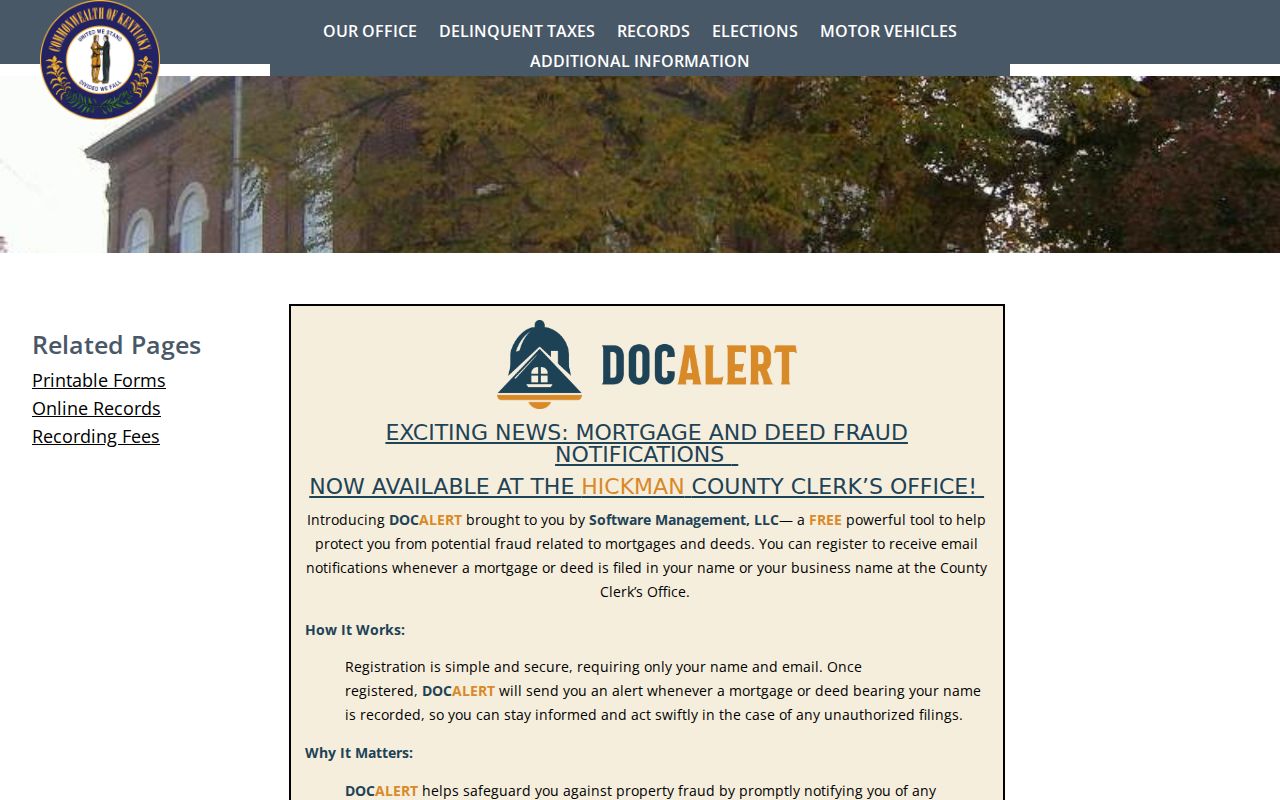
Think of the page as a routing guide. It steers researchers toward computer records, the rolodex, public Deed Room terminals, and older holdings. Nowhere does it promise that every deed image lives online.
Know Where Hickman County Former-Owner Records Stop
The sources disagree about where the record trail begins. The clerk cites deed and mortgage holdings back to 1795. Hickman County itself was organized in 1821, and KDLA's deed microfilm starts in 1822. Ask the clerk how the 1795–1821 material is arranged. The listed deed reels also show a gap from 1889 to 1901. That gap is a reason to consult local books and staff. It is not proof that anything was lost.
Nothing in the county's own accounts records a courthouse fire or a destroyed deed group. Treat a missing index entry as a search problem first. Try name variants, estates, trusts, legal descriptions, tax rolls, plats, and the counter. The goal is a supported sequence of former owners of record. Every gap should be labeled rather than silently filled.
Lawful use. Use previous-owner records for house history, estate work, title research, and property diligence. Never use public records to stalk, target, or harass a person.