
What Hickman County Property Tax Records Show
Each custodian answers a different question. The PVA assesses real property and prepares the annual roll but sets no rates, mails no bills, and collects nothing. The Sheriff takes current tax payments. Delinquent certificates and sales belong to the County Clerk.
| Field | What It Shows | Where |
|---|---|---|
| Land and improvements | Components used in assessment | Hickman County PVA |
| Fair cash value | January 1 valuation basis | Hickman County PVA |
| Exemption status | Adjustment shown on the assessment record | Hickman County PVA |
| Current bill and payment | Charge, balance and receipt question | Hickman County Sheriff |
| Delinquent certificate | Bill transferred into delinquency process | County Clerk |
Start with the PVA's assessed value. That is the fair figure on the annual tax roll. A tax bill then layers rates and exemptions onto the taxable base. Sale consideration from a deed is a transaction fact. It should never stand in for either number.
Hickman Assessments Use a January 1 Snapshot
Kentucky assesses real property every January 1. The PVA assessment-process page sets the standard at 100 percent fair cash value as of that date. Examiners walk each parcel once per four-year cycle. Methods vary. Sales comparison, cost, and income approaches all come into play as each parcel warrants.
A sale later in the year still leaves the seller on that tax bill until the roll updates the next January. That lag is timing, not a failed deed, so track the newest deed for current ownership and the tax-year roll for that year's assessment.
For valuation dates and the appeal sequence, the official assessment explanation governs.
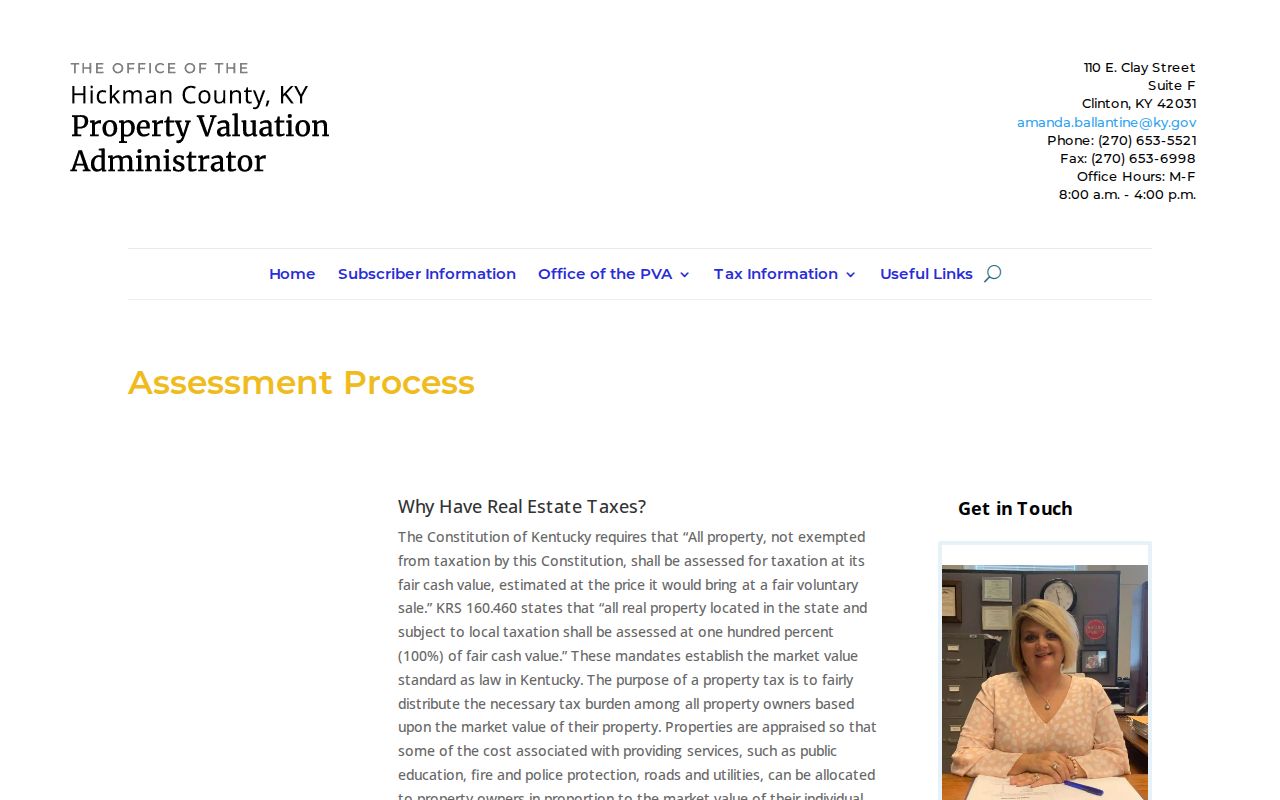
The captured guidance distinguishes the PVA's valuation work from tax-rate setting and bill collection.
Look Up a Hickman County Tax Bill
Hickman County publishes no official online current-bill search. Identify the assessment by address or parcel number. Then contact the Sheriff at 110 East Clay Street, Suite B, Clinton, 270-653-2241 for the current balance or a payment record.
- Search the PVA record by address, owner or parcel and note the assessment year.
- Give the parcel and owner details to the Sheriff for the current bill and payment status.
- Confirm exemption treatment with the PVA rather than inferring it from the balance.
- If delinquent, ask the Clerk whether a certificate exists and what amount controls.
- Assessed value
- The value placed on the annual property roll.
- Levy
- The rate applied by a taxing authority to the taxable base.
- Homestead exemption
- A qualification-based reduction administered through the PVA.
- Tax lien
- A public claim arising from unpaid tax, distinct from an ordinary bill.
Read Hickman Delinquent-Tax Listings Carefully
The Kentucky delinquent-tax list is informational. It flags current-year bills offered to third-party purchasers. Its own disclaimer puts the sole determination of actual dollars with the County Clerk. Kentucky Revenue guidance also requires certificates to run in a local newspaper. That notice must appear at least 30 days before a sale.
The Clerk's site has announced a sale for August 11, 2026 at 9 a.m. Third-party registration closes August 1. Dates and amounts shift, so confirm the current notice and balance with the Clerk first.
Note: A statewide listing is a lead; the Hickman County Clerk controls the certificate amount and local sale administration.
The statewide delinquent-bill listing supplies a county selection route for bills advertised for sale.
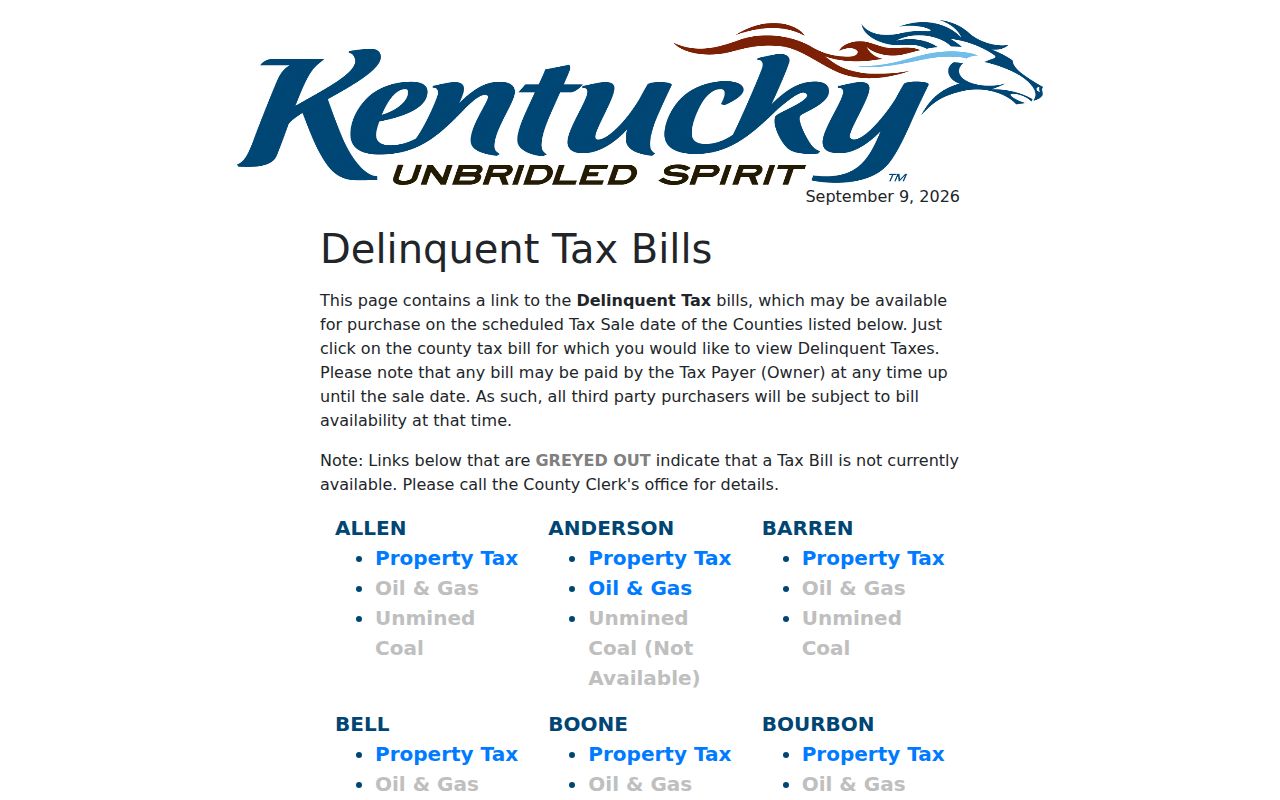
Note: carry any listed bill back to the Hickman County Clerk for the controlling amount and status.
Check Exemptions on the Hickman Assessment
Assessment questions go to the PVA, whose real-property guidance covers the ground. An exemption changes taxable value only. It does not touch deed ownership or market price. Ask the PVA which application applies. Ask which eligibility evidence and effective year apply. Do not guess from an owner's age, mailing address, or tax amount.
A parcel record may list an exemption category. The county publishes no confirmed set of live labels. For corrections or applications, call 270-653-5521 or visit Suite F during weekday hours.
Appeal a Hickman County Assessment
Start with a PVA conference during the inspection period. The documented window runs from the first Monday in May through the third Monday. Written conference scheduling is requested before that third Monday. An unresolved dispute goes to the county Board of Assessment Appeals. Strong evidence includes a recent appraisal, comparable sales, photographs, and documented condition errors.
Further review can move to the Kentucky Board of Tax Appeals and then to court. Confirm the calendar and forms with the PVA every year. A general summary never extends a statutory deadline.
Appeal window. Schedule the PVA conference within the May inspection period and verify the current filing deadline before submitting a Board of Assessment Appeals petition.
Prepare Evidence for a Hickman Value Review
Start with the parcel number. Add the tax year and the exact characteristic in dispute. Details matter. Set the PVA record beside photographs, measurements, a recent professional appraisal, arm's-length comparable sales, and documents showing condition. Tie every piece to January 1 fair cash value. A repair, sale, or market shift after that date belongs to a different valuation year.
Ask the PVA how the value breaks down. The office can explain land and improvement components, property classification, exemption treatment, and the valuation method used. A wrong characteristic needs correcting. An excessive value built on correct facts is a separate argument. Keep the conference result and submission dates, because a Board of Assessment Appeals filing depends on completing that local step.
The office at 110 East Clay Street, Suite F, Clinton, is open weekdays from 8 a.m. to 4 p.m., and a call ahead confirms the current form, appointment procedure, and evidence format. Call before the May inspection period.
Keep County and Clinton Tax Records Separate
A Clinton mailing address does not settle the question of who taxes the parcel. The county assessment and Sheriff bill apply everywhere. A city bill exists only for parcels inside the municipal boundary. Clinton mails its bills by October 1. A 2 percent discount runs through November 30. The face amount holds through December 31. A 5 percent penalty follows in January, and a 10 percent penalty kicks in after January 31. Those dates belong to the city alone. Never copy them onto a county bill without confirmation.
Each office holds a different piece of the tax roll. The PVA prepares the roll but sets no rates and collects nothing. The Sheriff handles current collection and receipts, while the Clerk keeps delinquent-certificate and sale records. A payment can seem missing. First pin down the bill year and the taxing authority. Then hand the parcel and receipt details to the right custodian. A paid county bill says nothing about a Clinton city bill.
Never infer delinquency from an old screenshot or an informational list. Ask the Clerk whether a certificate was paid, assigned, withdrawn or scheduled for sale. Get the current amount in writing. If the disposition affects a transaction, search the recorded releases or assignments.
On the rural edge of town, confirm the taxing jurisdiction. Do not trust the mailing city alone. ZIP 42031 can mean Clinton for postal purposes. The parcel may still sit outside the corporate boundary. Compare the PVA situs and legal description against current boundary information. Then ask City Hall whether a municipal bill applies. Keep the county parcel number on every inquiry. That way the PVA, Sheriff and Clerk all discuss the same tract and tax year.
A tax record is not an appraisal or a title report. It documents one year's assessment and collection. An appeal may call for a professional appraisal. A current conveyance question turns on the newest recorded deed.